For informational purposes only — not medical advice. See our Medical & Health Disclaimer.
The nursery may be ready, but changing table safety can still make a new mom nervous. You may search “how safe is a changing table?” at 2 a.m. after imagining your baby rolling away. Those worries feel intense because diaper changes happen so often, especially during the first months.
Soon, however, changing your baby becomes part of your daily rhythm. You talk, sing, smile, and reach for another diaper without thinking. Still, one quick reach can create a dangerous moment.
The good news is that simple habits can make these everyday moments much safer.
Why Changing Table Safety Matters
Newborns may look too small to move very far. Yet babies can surprise you with sudden rolls, kicks, and twists. Therefore, you should never assume your baby cannot move.
The U.S. Consumer Product Safety Commission (CPSC) has reported thousands of emergency department visits involving changing products. Falls remain a major concern. CPSC changing table safety guidance
More importantly, these accidents do not mean someone was a bad parent. Often, the problem starts with one ordinary distraction.
The phone rings. A wipe falls. Your toddler calls from the hallway. Suddenly, the thing you thought would take two seconds becomes a risk.
That is why changing table safety depends more on habits than perfection.
Changing Table Safety: The Most Important Rule
Never leave your baby alone on a changing table. Not even for a moment.
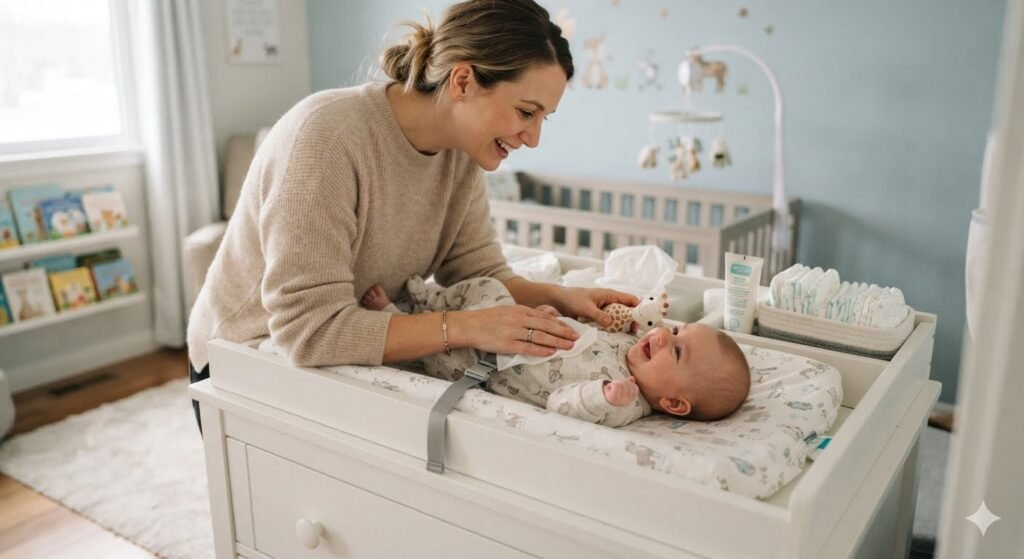
If you need another diaper, grab it before starting. Likewise, keep wipes, cream, clothing, and other supplies within easy reach.
Most importantly, keep one hand on your baby whenever possible. A hand resting gently on the baby’s tummy or leg can become an automatic safety habit.
Safety straps can provide another layer of protection. However, they should never replace your hand or your attention.
For that reason, prepare the entire changing area before placing your baby down. A few seconds of preparation can prevent a frightening situation.
Choose a Safer Changing Table
The changing table itself also deserves careful attention. Look for a sturdy design that does not wobble or shift during use.
Check the manufacturer’s instructions and weight limits before buying. Also, inspect screws, joints, straps, and other hardware regularly.
A changing pad should fit securely on the table. It should not slide easily when your baby moves.
Additionally, follow the safety instructions that come with the specific product. Current federal requirements and applicable ASTM standards can help guide safer product selection. CPSC product safety resources
Remember, a certification or safety feature does not make unattended use safe. Your attention remains the most important protection.
Make the Nursery Easier to Manage
A safe nursery does not need to look perfect. Instead, it should make safe choices easier when you are exhausted.
Keep frequently used supplies together. Store extras in drawers or baskets that you can reach without leaving your baby.
You can also create a small changing station on another safe surface for emergencies. However, never place your baby on a bed, sofa, or other soft surface and assume it is safer.
If diaper changes regularly cause irritation, our Diaper Rash Prevention: How to Avoid Pain guide can help you build a simple care routine.
Meanwhile, if your baby cries during changes, Comforting Your Baby: How to Understand Crying offers ideas for understanding those difficult moments.
Nursery Air Quality Matters Too
The changing table is only one part of a healthy nursery. Air quality also matters, especially when your baby spends many hours indoors.
The Environmental Protection Agency recommends keeping indoor relative humidity between 30% and 50%. This range can help limit problems linked with excessive moisture and dry indoor air. EPA: Indoor Air Quality and Humidity
Therefore, avoid turning a humidifier into an automatic part of every bedtime routine. Too much moisture can encourage mold and dust mites.
If you are considering one, read our Baby Humidifier Advice: Is It Good or Bad?.
For families considering air filtration, our Best Air Purifiers: Baby Breathing Easy guide can help explain the differences between common options.
Should You Use a Humidifier or Air Purifier?
These products serve different purposes. A humidifier adds moisture to indoor air, while an air purifier can filter certain airborne particles.
Consequently, buying both does not automatically create a healthier nursery. Your home’s conditions should guide the decision.
A cool-mist humidifier may be preferable to a warm-mist model around children because hot water and steam can cause burns. Always follow the manufacturer’s cleaning instructions.
Furthermore, never allow water to sit inside a dirty humidifier. Regular cleaning matters because contaminated units can release unwanted material into the air.
A simple humidity monitor can also help you avoid guessing. Instead of running a humidifier all night, check the actual room conditions first.
The Emotional Side of Nursery Safety
New motherhood can turn ordinary objects into sources of worry. A changing table may suddenly feel dangerous. A humidifier may make you wonder about mold. Even the nursery air can become something you search online at midnight.
Those fears often come from love, not failure.
You are trying to protect someone who depends completely on you. Naturally, that responsibility can feel enormous.
Still, you do not need to create a perfect nursery. You need a practical space where safe habits become easy.
The same idea applies to sleep. If your baby is beginning to roll, our Sleep Sack for Rolling Baby guide can help you think through the next stage.
Holding Safety and Motherhood Together
There will be days when the nursery looks messy. Sometimes the laundry will stay in a basket. On other mornings, you may forget to check the humidity.
That does not make you careless.
Instead, focus on the habits that have the biggest impact. Prepare supplies before diaper changes. Keep one hand on your baby. Never walk away from the changing surface.
Then breathe.
Your baby does not need a perfect mother or a showroom nursery. Your baby needs a mother who keeps learning, adjusts when something feels unsafe, and asks for help when she needs it.
What You Will Remember
Years from now, you probably will not remember the exact brand of changing table you purchased.
You may remember the tiny feet kicking during diaper changes. Perhaps you will remember singing at 3 a.m. while your baby stared back at you.
You will remember the tired nights, too.
That is what makes nursery safety so meaningful. You are not simply arranging furniture. You are creating a place where ordinary moments can happen with fewer preventable risks.
Changing table safety is not about living in fear. It is about turning smart precautions into everyday habits.
This article uses information from the U.S. Consumer Product Safety Commission (CPSC) and U.S. Environmental Protection Agency (EPA). Product standards and recommendations can change, so parents should always check current manufacturer instructions and consult their pediatrician for individual concerns.
This article is educational and does not replace professional medical or safety advice.
Written by Fran & Fabio, founders of New Mom Choice. Fran is a dentist. Fabio is a retired agricultural pilot. Together, they research and fact-check every guide on this site against trusted medical sources — including the AAP and WHO — before it goes live.